
What Are Solid State Drives? Your Guide to Blazing Fast Storage
Unlock unparalleled speed and efficiency for your computer with an in-depth look at solid state drive technology.
Explore SSD BenefitsKey Takeaways
- ✓ SSDs use flash memory (NAND) instead of spinning platters.
- ✓ They offer significantly faster boot times and application loading.
- ✓ SSDs are more durable and consume less power than traditional HDDs.
- ✓ Prices have become more affordable, making them accessible for most users.
How It Works
Instead of magnetic platters, SSDs store data in interconnected flash memory cells. These cells are organized into blocks and pages.
A sophisticated controller acts as the brain, managing data flow, wear leveling, error correction, and garbage collection to optimize performance and lifespan.
When you save or retrieve data, electrical signals are sent through these flash memory cells. This allows for instantaneous access without mechanical movement.
The absence of mechanical components is key. This design eliminates latency associated with physical read/write heads and spinning disks, leading to superior speed.
Understanding the Fundamentals of Solid State Drive Technology
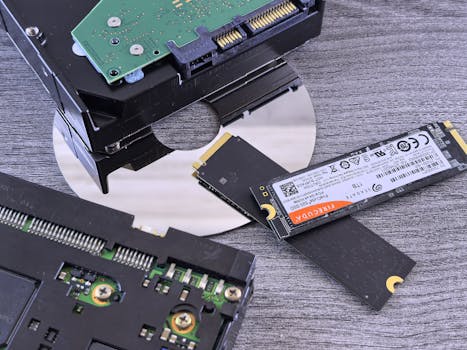 Photo: Andrey Matveev / Pexels
The Unmatched Performance Benefits of SSDs Over HDDs
 Photo: Andrey Matveev / Pexels
Navigating the Different Types of SSDs and Their Interfaces
Photo: Andrey Matveev / Pexels
Maximizing Your SSD's Lifespan and Performance: Essential Tips
Comparison
| Feature | SSD (NVMe) | SSD (SATA) | HDD (7200 RPM) |
|---|---|---|---|
| Speed (Seq. Read) | Up to 7000 MB/s | Up to 550 MB/s | Up to 200 MB/s |
| Boot Time | 5-10 seconds | 10-20 seconds | 30-90 seconds |
| Durability | Excellent (no moving parts) | Excellent (no moving parts) | Poor (mechanical parts) |
| Power Consumption | Low | Low | Medium |
| Noise Level | Silent | Silent | Audible |
| Cost per GB | High | Medium | Low |
| Form Factors | M.2, PCIe AIC | 2.5-inch | 3.5-inch, 2.5-inch |
| Ideal Use | OS, Apps, Gaming, Pro Work | OS, Apps, General Use | Bulk Storage, Archiving |
What Readers Say
"Upgrading to an SSD completely transformed my old laptop. It boots up in seconds now, and applications launch instantly. I finally understand what are solid state drives and why everyone raves about them!"
Sarah J. · Austin, TX"I replaced my HDD with an NVMe SSD, and the difference in gaming load times is incredible. No more waiting around, just pure speed. Best upgrade I've made in years."
Mark D. · Seattle, WA"My work involves large video files, and the constant reading/writing was a nightmare on my old drive. Since switching to an SSD, my workflow is so much smoother, saving me hours each week. It's truly a game-changer for productivity."
Emily R. · Miami, FL"While the speed is fantastic, the price per gigabyte for the larger capacity SSDs is still a bit high for me. I ended up getting a smaller one for my OS and a traditional hard drive for my media files, which works well."
Chris P. · Denver, CO"As a graphic designer, I need my software to respond instantly. My new M.2 NVMe SSD makes Photoshop and Illustrator feel incredibly snappy. It's a must-have for creative professionals, dramatically improving efficiency."
Jessica L. · Chicago, ILFrequently Asked Questions
What is the main advantage of solid state drives over traditional hard drives?
The main advantage of solid state drives (SSDs) is their speed. Because they use flash memory and have no moving parts, they can access data significantly faster than traditional hard disk drives (HDDs). This results in quicker boot times, faster application loading, and much snappier overall system responsiveness compared to an HDD.
Are solid state drives more reliable than HDDs?
Generally, yes. SSDs are more reliable in terms of physical durability because they lack moving parts that can fail due to drops or vibrations. While both have finite lifespans based on write cycles, for typical consumer use, an SSD is less prone to mechanical failure than an HDD.
How do I install a solid state drive in my computer?
Installation varies by type. A 2.5-inch SATA SSD typically mounts into a drive bay and connects via SATA data and power cables. An M.2 NVMe SSD plugs directly into an M.2 slot on your motherboard and is secured with a screw. Always consult your computer or motherboard manual for specific installation instructions.
Are solid state drives expensive?
While SSDs used to be significantly more expensive than HDDs, their prices have dropped considerably over the years, making them very affordable for most users. High-capacity NVMe SSDs still carry a premium, but the performance benefits often justify the cost, especially for your primary system drive.
Can I use both an SSD and an HDD in the same computer?
Absolutely! This is a very common and recommended setup. You can install your operating system and frequently used applications on a smaller, faster SSD for performance, and then use a larger, more affordable HDD for bulk storage of documents, photos, videos, and games that don't require super-fast loading.
Who should consider upgrading to what are solid state drives?
Anyone looking to significantly improve their computer's performance should consider an SSD. This includes gamers, content creators, professionals, and even casual users who want faster boot times and a more responsive system. It's one of the most impactful upgrades you can make.
Do solid state drives have a limited lifespan due to write cycles?
Yes, SSDs do have a finite number of write cycles, meaning each memory cell can only be written to a certain number of times before it degrades. However, modern SSDs incorporate advanced wear-leveling algorithms and have very high endurance ratings (TBW - Terabytes Written), making their lifespan far exceed typical consumer usage, usually lasting many years.
What future trends are expected for solid state drives?
Future trends for SSDs include even faster NVMe generations (like PCIe Gen 5 and beyond), higher capacities, and further reductions in cost per gigabyte. We can also expect continued advancements in NAND flash technology, leading to denser storage and improved endurance, as well as new form factors for specialized applications.
Now that you understand what are solid state drives and their profound impact on computing, consider making the upgrade. Experience the difference in speed, durability, and efficiency firsthand, and unlock the full potential of your PC. Your computer will thank you.